
Written by Roy Ingente
“Kompartable Ra Ba Ka?”
Studio Arts II – University of the Philippines
Cebu Installation – MINDWORKS, 2025
Within the rapidly transforming urban landscape of Cebu City—where new commercial towers rise alongside older neighborhoods and port-driven economies signal the promise of expansion—questions of equity and lived experience continue to surface with pressing urgency. It is within this environment that the installation Komportable Ra Ba Ka? emerges as a poignant reflection on the uneven terrain of prosperity in the Philippines. Conceived by a group of young Cebuano artists from the University of the Philippines Cebu- Second Year Level Studio Arts Program, the work confronts audiences with a question that feels at once intimate and political: Are you truly comfortable?
The installation is presented within the context of Mindworks, a long-standing artist-led platform that has shaped the contemporary art ecology of Cebu for more than four decades. Established and sustained through the efforts of practicing artists and cultural workers, Mindworks has become one of the region’s most enduring experimental gatherings—an event that foregrounds installation art, performances, happenings, artist talks, and workshops led by prominent Cebu-based practitioners and specialists. Over the years, the festival has cultivated an environment where artistic inquiry and community dialogue intersect, allowing artists to respond directly to the social realities of their surroundings.
The 2025 edition of Mindworks adopted the theme ANTOS–SANTOS, a Cebuano phrase that speaks to the act of enduring hardship while simultaneously invoking the image of the saint or martyr. The phrase captures a tension deeply embedded within Filipino culture: the capacity to withstand adversity with patience, resilience, and faith. In a society marked by persistent economic disparity, this cultural ethic often becomes both a source of strength and a mirror reflecting systemic inequality.
Against this thematic backdrop, Komportable Ra Ba Ka? unfolds as a critical and experiential meditation on the contradictions of comfort within contemporary Filipino life.
The title borrows from the cadence of everyday Cebuano conversation—“Hi, nikaon na ka?” or “Naa ra ka’y kwarta pang palit ug pagkaon?” These simple questions, often spoken with genuine care, operate as gestures of communal empathy. Yet they also quietly reveal the precarious conditions under which many Filipinos navigate their daily existence. In a nation where the average household income remains modest while extraordinary wealth is concentrated among a small elite, the language of comfort inevitably becomes entangled with questions of access, dignity, and survival.
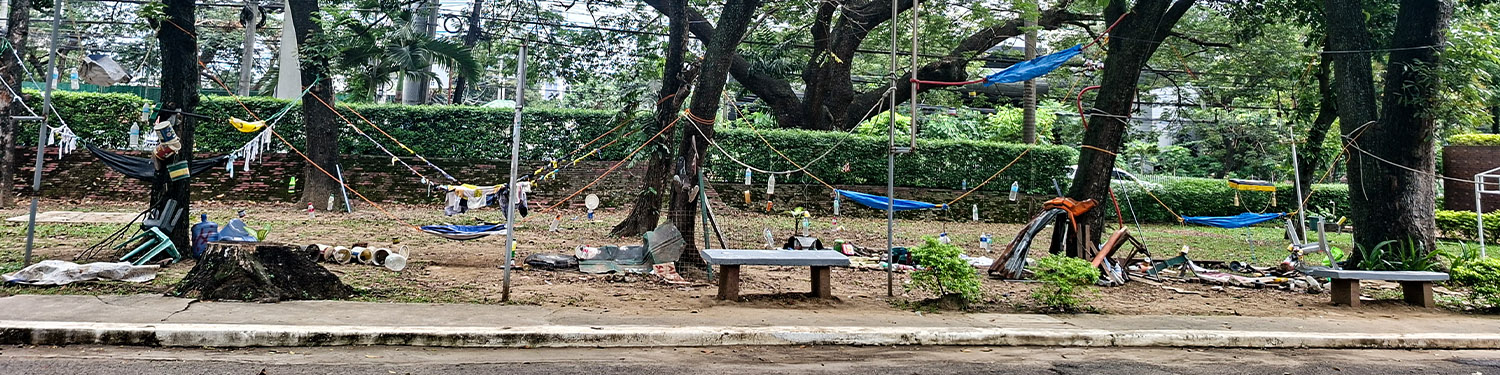
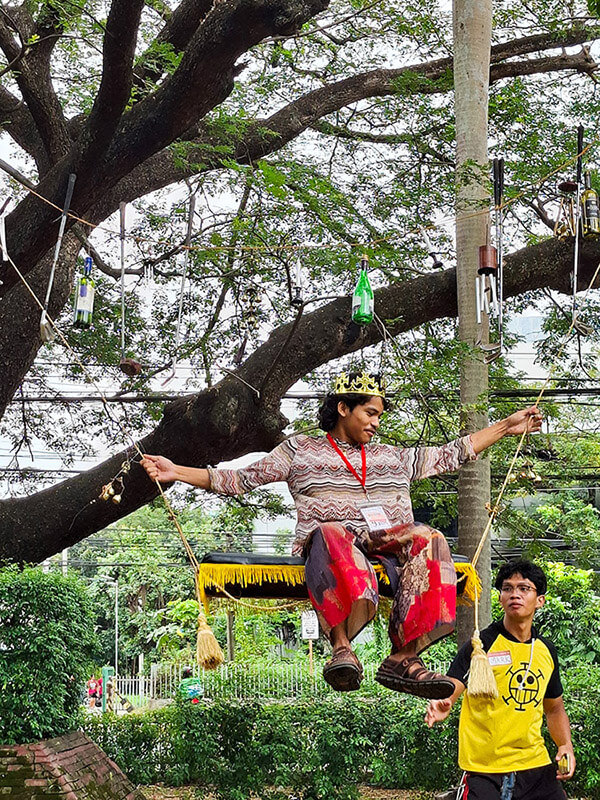
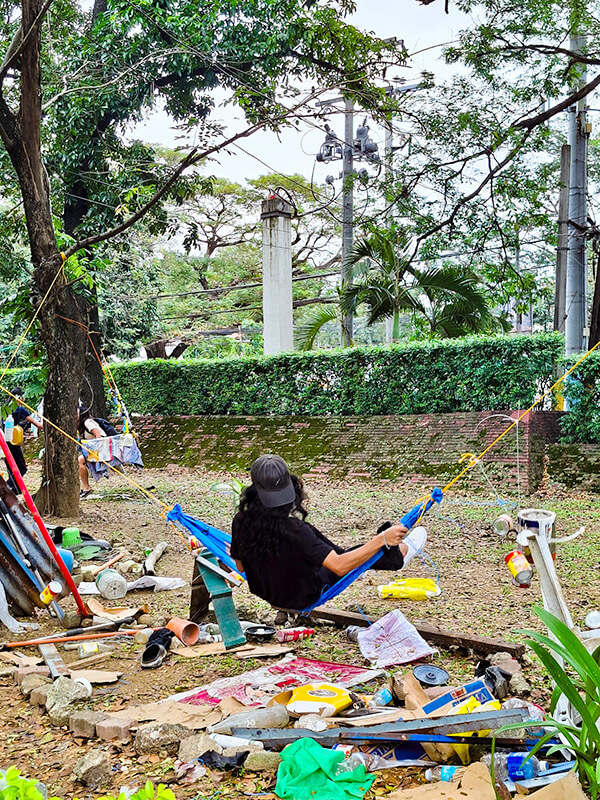
At the heart of the installation is a constellation of duyan—traditional Filipino swings that typically evoke rest, childhood, and moments of quiet reprieve beneath a tree. Within this installation, however, the duyan are transformed into instruments of social reflection. Each swing is placed within a designated spatial zone corresponding to differing socioeconomic conditions within Filipino society: the lower, middle, and upper classes.
Through carefully selected materials and objects attached to each swing, the artists construct tangible interpretations of these contrasting realities. Domestic fragments, improvised tools, consumer objects, and symbolic materials accumulate upon the structures, creating assemblages that embody the textures of different livelihoods.
When activated by visitors, the swings produce an unexpected cacophony of sound. Metal collides with glass, plastic rattles against wood, loose objects clash in irregular rhythms. What initially promises rest becomes an uneasy sonic disturbance.
The duyan, long associated with comfort, becomes destabilized.
The act of swinging—traditionally linked to equilibrium and calm—reveals instead a precarious oscillation between stability and disruption. Within this simple yet profound gesture, the artists articulate one of the central contradictions of contemporary Filipino life: the illusion of security within systems that remain structurally fragile.
As audiences move through the installation, the contrasts become physically legible. One space may evoke the improvisational resilience characteristic of working-class households, where survival often depends upon resourcefulness and communal support. Another environment reflects the aspirational consumption associated with the middle class, where material objects accumulate alongside anxieties of economic mobility. Elsewhere, abundance becomes almost theatrical, revealing the disproportionate concentration of wealth among the country’s elite.
Rather than presenting inequality as a distant statistical abstraction, the installation translates economic disparity into embodied experience. Sound, motion, and spatial proximity become the language through which social realities are felt.
In the context of a city like Cebu City—one of the Philippines’ fastest-growing economic centers—the work resonates with particular clarity. Rapid urban development has introduced new infrastructures of commerce and tourism, yet these transformations often unfold alongside persistent disparities in opportunity and access. Luxury condominiums stand within view of densely populated communities; new wealth circulates even as many households continue to navigate precarious conditions.
Within the framework of Mindworks Festival and its theme ANTOS–SANTOS, the installation gains additional resonance. The concept of antos—to endure—echoes throughout the experience of the swings themselves. Participants attempt to find comfort, yet are confronted by disruption and imbalance. The duyan offers rest, but never complete silence.
The work therefore becomes a metaphor for the lived condition of many Filipinos: a continuous negotiation between resilience and vulnerability.
Yet embedded within this tension is also a subtle acknowledgment of collective strength. The duyan does not collapse; it continues to move. The sounds generated through interaction form a shared acoustic environment, reminding viewers that social realities are produced collectively, shaped by both individual actions and systemic structures.
The installation demonstrates the power of artist-led initiatives like Mindworks to create spaces where complex social issues can be encountered not merely as discourse but as lived experience. The work exemplifies how regional artistic communities—particularly those operating outside dominant cultural capitals—can generate forms of critique that are deeply rooted in local language, tradition, and communal sensibility.
Within the evolving cultural and economic landscape of Cebu, the installation invites viewers to consider not only their own positions within systems of inequality, but also the forms of solidarity, awareness, and action that might emerge once comfort itself is placed under scrutiny.