
PHIL SEVILLA, 49TH Joya Awards – Grand Prize Awardee
What remains of a home once its walls have been dismantled? When architecture disappears, memory does not vanish with it; instead, it lingers in fragments—within the objects that once filled a room, within the surfaces that absorbed the rhythms of everyday life, and within the materials that quietly bore witness to the passage of time. In this body of work, Phil Sevilla approachesthese fragments not simply as debris but as living carriers of memory. Through a process that merges personal mourning with collective reflection, Sevilla transforms the remnants of demolition into a material language of care, endurance, and remembrance.
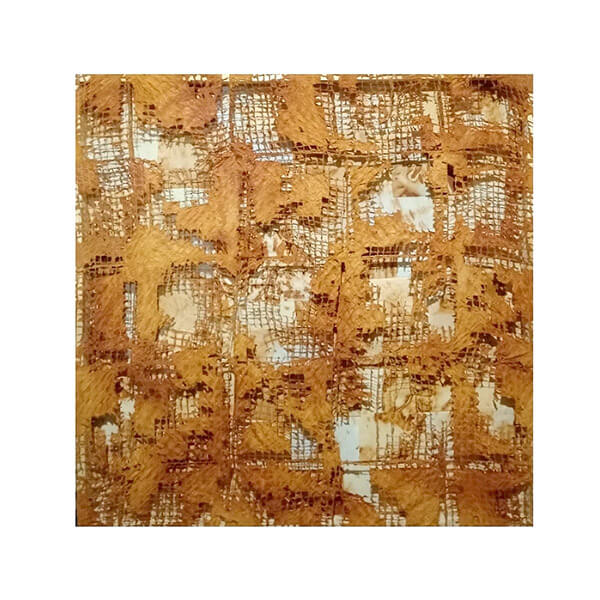
Title: WHAT REMAINS
Artist: PHIL SEVILLA (49TH Joya Awards – Grand Prize Awardee Artwork)
Dimensions: 91.44cm x 91.44cm Year: 2025
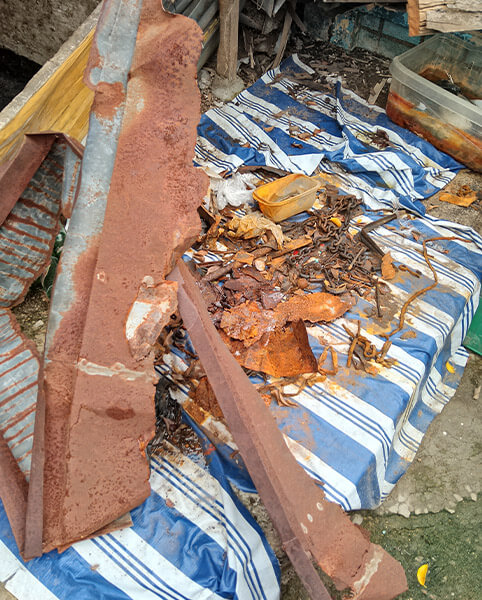
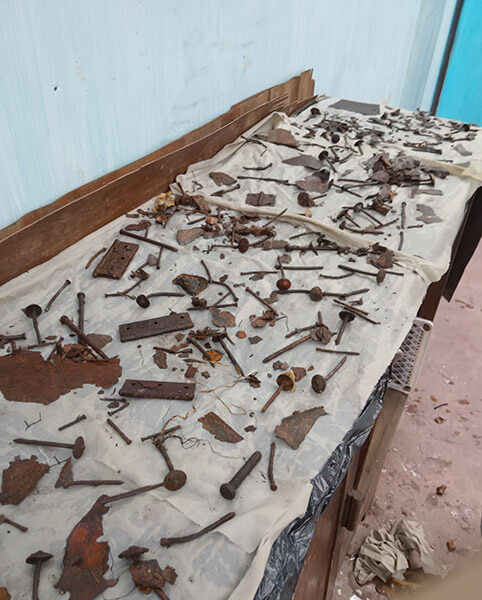
The project emerges from the demolition of Sevilla’s family home and the wider displacement experienced within the community of Sitio Sto. Niño. Yet rather than framing loss solely as absence, Sevilla turns toward the materials left behind—rusted nails, fragments of roofing, and discarded domestic substrates—as points of connection between past and present. In doing so, the artist asks how the physical residues of a place might continue to speak long after the structures themselves have disappeared.
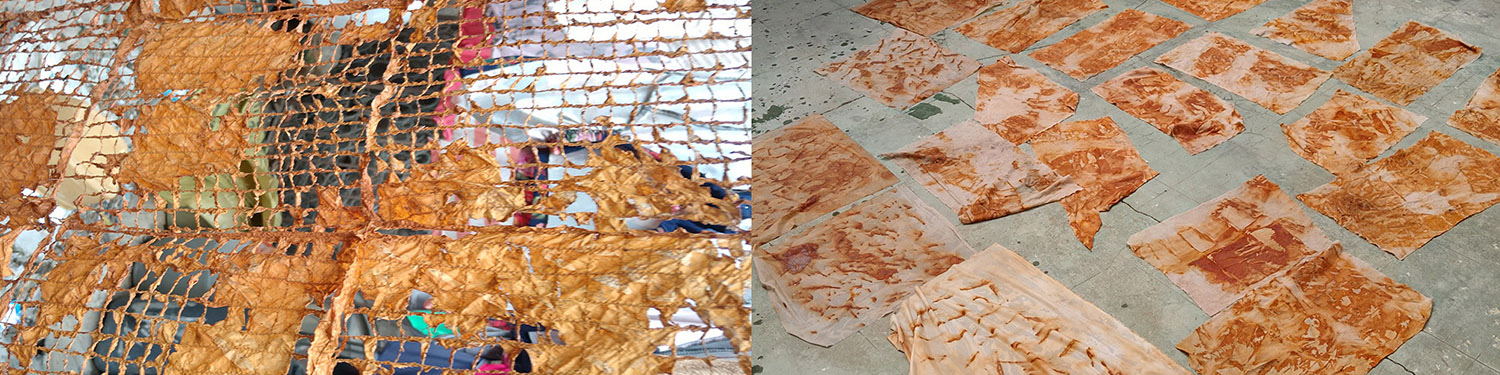
At the center of Sevilla’s practice is rust dyeing, a slow and intimate process in which oxidized metal leaves its imprint upon fabric and paper through moisture, time, and chemical reaction. Metal elements salvaged from demolished houses are placed in contact with discarded textiles and used papers, many of which once circulated within the homes of the community itself. As oxidation spreads across the surface, rust blooms into delicate fields of organic patterns—stains that carry the quiet record of time, weather, and transformation.
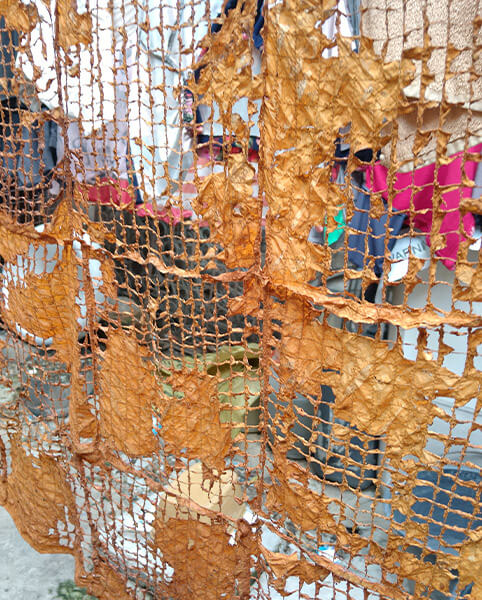
In Sevilla’s work, rust is not treated as damage but as a form of inscription. What is often regarded as evidence of deterioration becomes instead a tender mark of presence. Each imprint records a moment of contact between material and memory, allowing fragments of demolished architecture to leave behind spectral yet persistent traces. Through this process, corrosion becomes a medium of storytelling, revealing how decay itself can hold within it the possibility of continuity.
After the dyeing process, Sevilla introduces a gesture that is both humble and deeply intimate: the careful stitching of fragile grids across the rust-marked paper surfaces. Thread passes repeatedly through the delicate material, forming structures that appear at once restrained and quietly emotional. The grid, often associated with formal order, becomes here an act of mending—a slow choreography of hands that echoes the quiet forms of labor through which homes and communities are sustained.
These stitched interventions transform the surface into a site of care. Each thread holds together fragile fibers, suggesting the human impulse to repair, to gather, and to remember.
In Sevilla’s hands, stitching becomes less about control and more about tenderness—a gesture that acknowledges fragility while refusing to let it dissolve into silence.
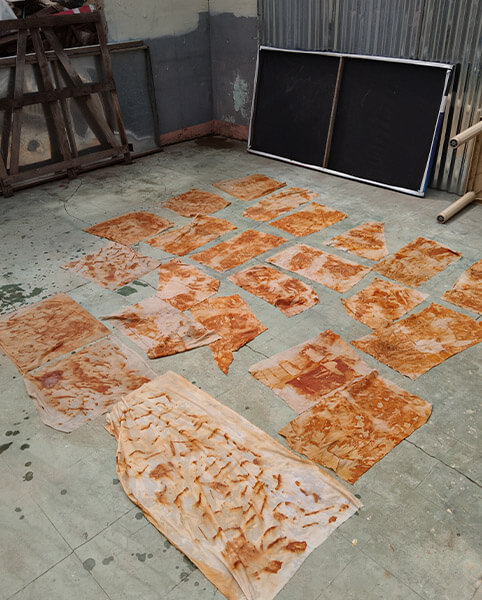
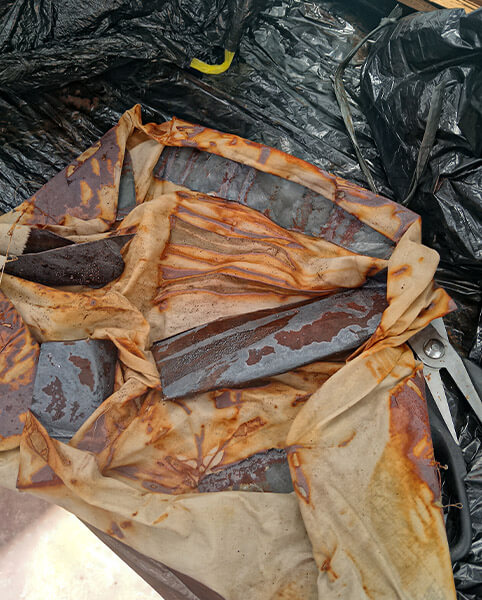
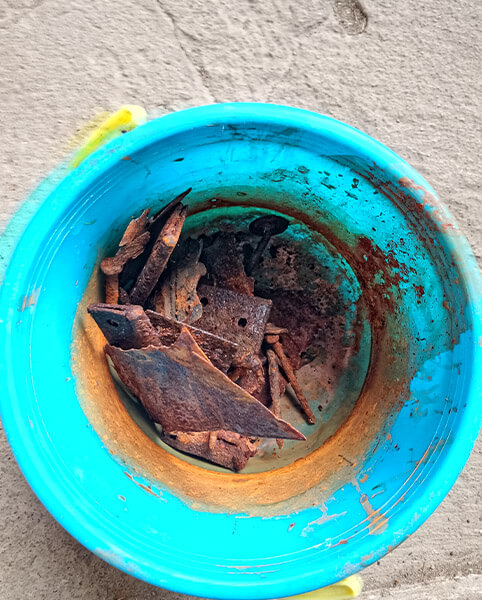
The works take shape as patchwork constellations of fabric and paper, assembled from fragments that might otherwise have been discarded. This patchwork structure carries with it the emotional resonance of collective survival: the piecing together of what remains, the patient assembling of memory from scattered parts. Rusted impressions spread across the surfaces like quiet maps of what once stood—subtle cartographies of absence, presence, and transformation.
Although rooted in Sevilla’s personal experience, the work resonates deeply with the shared realities of Sitio Sto. Niño. Across the community, houses have been dismantled, landscapes altered, and lives reshaped by forces beyond the control of those who once called these spaces home. Within this context, Sevilla’s practice becomes an act of communal remembering. By retrieving architectural remnants and domestic materials from these sites, the artist allows the community itself to remain present within the work.
In this way, Phil Sevilla’s practice moves beyond documentation. It becomes a gesture of love—for place, for memory, and for the quiet resilience of the people who inhabit these spaces. The materials carry not only traces of demolition but also the enduring presence of the lives that once animated them. Each rusted imprint, each fragile stitch, becomes a testament to the emotional landscapes that survive even after physical structures are gone.
Ultimately, the work invites us to reconsider what it means to preserve a home. It suggests that home may not reside solely within architecture, but within the memories embedded in the materials that once surrounded us. Through rust, thread, and the humble gathering of discarded fragments, Sevilla constructs a space where loss is transformed into reflection, and where decay becomes a tender act of remembering.
In this quiet yet powerful gesture, art becomes a form of care. It becomes a way of holding space for community, of honoring the fragile beauty of lived experience, and of allowing memory—like rust spreading gently across cloth—to continue unfolding long after the walls have disappeared.